Understand the field first,
then decide if you want in
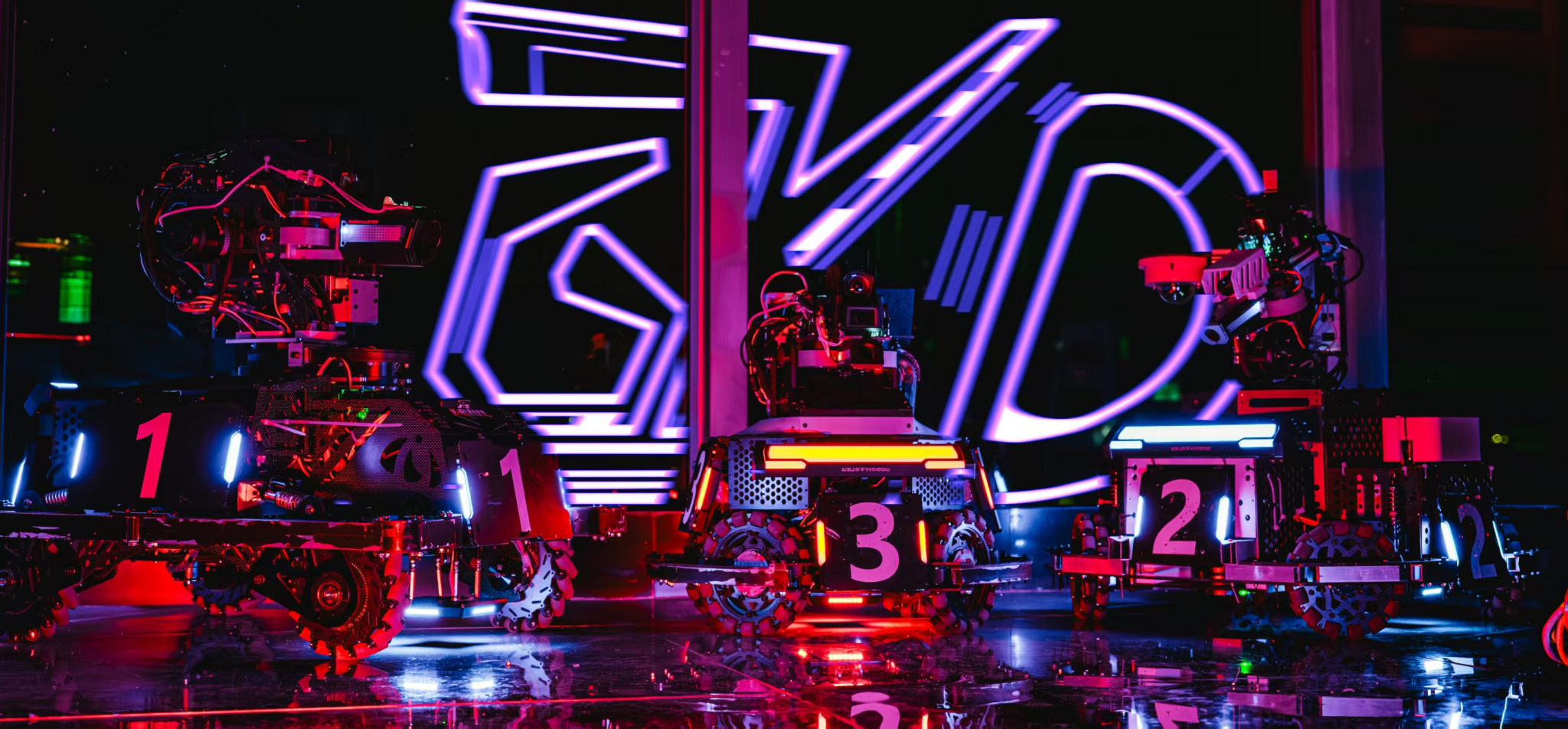
The RoboMaster University League (RMUL) is open to universities worldwide. It challenges teams to combine mechanical, electronic, control, software and computer-science skills, and to carry a robot all the way from design to real competition.
See how a 3V3 match works
Below is the official RoboMaster introduction to the RMUL 2026 University League 3V3 rules. If this is your first contact with the competition, watch the video first, then come back to read about the robot types and how the work is split.
Video from the official RoboMaster account. For actual competition, always refer to the current season's official rules manual, robot construction specification and competition handbook.
Each robot does a different job
Below we cover the three types: infantry, heavy and sentry. Sentry figures follow the 2025 University League rules manual. For exact dimensions, HP, power, ammunition and field limits, always check the current season's construction specification and rules.
Infantry robot
The infantry robot is the workhorse of the field, carrying a 17 mm launcher and balancing mobility, firepower and sustained combat. It is also the robot new members get closest to and learn on first. It has to move fast, fight head-on and contest key areas — so the chassis must respond quickly, the gimbal must stay stable while moving, and the auto-aim system must keep detecting and tracking targets.
17 mm projectiles · high mobility · head-on fights · all-round combatHeavy robot
The heavy robot is the team's heavy firepower and the only one of the three firing 42 mm projectiles. Every shot counts, so it focuses on long-range precision: a stable gimbal, accurate vision solving and a reliable launcher to hit key targets with limited opportunities. The larger projectile also makes its feeding, launcher design and overall structure clearly different from the other types.
42 mm projectiles · heavy firepower · long range · precision shootingSentry robot
The sentry must run fully autonomously and is the only unit in a 3V3 line-up without an operator, carrying one 17 mm launcher. On the field it relies solely on its own sensors and onboard computing to search, decide and shoot — so it is far more than a goalie. It is a complete autonomous system combining localisation, navigation, target recognition, decision-making, motion control and automatic firing.
fully autonomous · no operator · onboard perception and decisions · localisation and navigationLinking the directions into one development chain
A robot that can compete is five directions each delivering their part, then fitting together. The split below is an interface agreement — not a set of unrelated modules.
| Stage | What it actually solves | GKD group |
|---|---|---|
| Mechanical structure | Size and strength, assembly order, transmissions, and space for the referee system | Mechanical |
| Electronics and power | Main controller and driver boards, power distribution, supercapacitors, power budgeting and the whole robot's wiring | Hardware |
| Control and communication | Motor closed loops, chassis and gimbal motion, state machines, CAN and serial communication | Control |
| Perception and aiming | Armour-plate detection, target tracking and motion prediction, feeding target data to the control group in real time | Vision |
| Localisation and navigation | Sentry localisation and mapping, destination decisions and path planning (the only uncrewed unit on the field) | Navigation |